
Cardiologists have used dedicated reporting software for years. These tools provide structure to their reports and guide their thinking on what echocardiographic features and measurements they should be reporting on.
For this same length of time, many have also used ultrasound machines which perform some automated measurements; most commonly, tracing the left ventricle for strain calculations, measuring the peak on a Doppler waveform, or tracing the Doppler envelope to deliver a velocity time integral (VTI).
There was never any concern that these automations could introduce error because it is assumed that expert cardiologists will instantly spot and correct these (in fact, on-cart automation, even from the biggest names in cardiology, routinely overestimates the Doppler envelope and peak, but this is a discussion for another day).
For most first opinion veterinarians, a software license for reporting software has been not only inaccessible (for EchoPac, for example, you have to be using a GE ultrasound machine), but with licenses priced at around £8,000 per user per year, financially unjustifiable.
The lack of an affordable and truly vendor-neutral option has significantly held back the progress of many first opinion vets who want to do well with echocardiography, as has the assumption underlying all existing echocardiography reporting software that the end user is always a cardiologist or a specialist echocardiographer (and that the patient is simply a miniature human!). Unused parameters (such as global longitudinal strain) cause confusion and distraction, and serve as a barrier to entry for those outside of the cardiology community.
Now, for the first time, small animal veterinarians are able to access software built specifically for them. Not human cardiology software inferring onto animals, but a truly veterinary, vendor-neutral, affordable reporting platform.
What are the risks?
There is concern, and not without merit, that using software which is operating outside of one’s own area of expertise can be dangerous. Creating cardiology software for non-cardiologists could be difficult for users to critically assess. Indeed, this is one of our major criticisms of fully automated echocardiography reporting software, which repurposes white label large language models to create a full, written echo report. Without any restrictions on what it can imagine and write, it is very difficult for human users, particularly novices, to critically check its very convincing outputs.
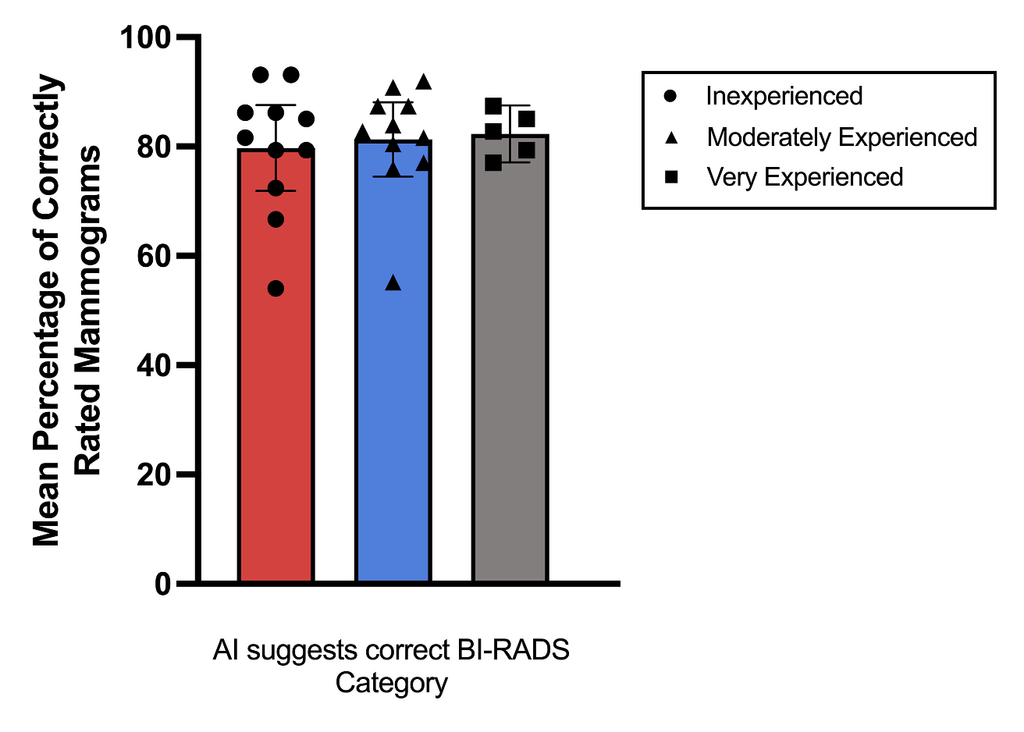
Automated measurement software like Quantum is very different. It does not create, fabricate, justify or persuade. In fact, it does not write at all. It applies a standardised measurement technique, in accordance with available guidelines, to automate the time-consuming, repetitive work of placing measurement points with callipers. These are measurements that novices will be performing unaided anyway, and we now have a lot of research that shows that novices aided by artificial intelligence perform significantly better than when working on their own, and indeed, can perform close to the level of experts.
The graph to the right is taken from a study by Dratsch et al. (2023), and shows how the performance of inexperienced and moderately experienced readers matches that of experienced readers when assisted with artificial intelligence in interpreting mammograms.
It knows that one measurement in dogs uses one technique, and in cats, another. It knows what to do when measuring wall thickness in an animal where there are regions of focal thickening. It not only knows it today, but it knows it next year, too – it doesn’t forget, change its mind, fall into bad habits, or change operator – meaning that measurements are always reproducible, and biological and physiological changes in the heart can be accurately tracked over time.
No automated system is perfect, however. Our neural networks are trained by humans and inherit our own weaknesses (such as our poorer measurement reproducibility when image quality is poor), and it can make mistakes.
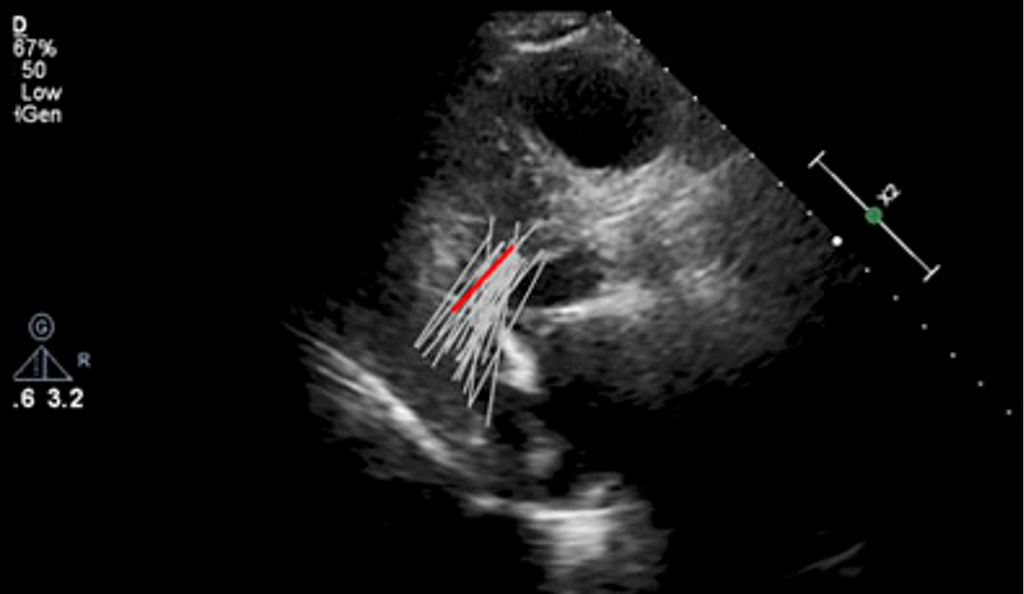
In the image shown here from Howard et al. (2021), individual human experts’ measurements are in grey, and the AI is shown in red. You can see that when image quality is very poor, even experienced cardiologists do not agree very closely with each other. Any AI system trained on these expert opinions will inherit the same difficulties as the experts faced when interpreting low-quality images.
The concern is that if the human user does not know how to correctly perform the measurement in question, they might not be in a position to notice or correct that error. So how can we protect against such errors?
Software creators have a responsibility
There is no doubt in our minds that the moment artificial intelligence or automated systems cross over from research into clinical deployment, companies have a responsibility to make it easy and obvious to users on how they can use it safely. This is even more important in veterinary medicine, where the default assumption inherited from human medicine – that the end-user is going to be a cardiologist or a specialist echocardiographer – is, in most instances, going to be false.
In our research, we always publish our failures (see example image above). We also openly publish our AI’s performance over the full dataset – not only its best cases. This is known as the data’s ‘long tail’ (Shun-Shin, 2026). This same transparency is implemented in our software by making sure that Quantum highlights its uncertainties and potential errors, instead of hiding them.
One of Quantum’s inbuilt safeguards that signals to users when it is unsure is its confidence level, which accompanies every measurement. Quantum refuses to auto-accept any measurement it feels uncertain about. It also provides an explanation for why it is not confident in a particular measurement – such as the image quality being low. All valid measurements that Quantum has deemed of sufficient quality are plotted along a line, which instantly draws the attention of the user to outliers, which they can select for closer inspection and then accept, reject or edit.
Nevertheless, with over 100 parameters inside Quantum, a novice user could easily find themselves in a situation where they are required to sense-check a measurement for which they have little or no experience. For this reason, we have now introduced measurement filters into Quantum. When you sign up to your free trial, one of our team will schedule a (free) onboarding call with you to go through which echo measurements you routinely use and feel comfortable with. For the first few weeks, you will familiarise yourself with the software using only these measurements. In your follow up call with us, we can then unlock additional measurements that you would like to start integrating into your examinations.
This means that you are fully in control over which measurements are performed, and the software is never getting ahead of itself and presenting you with measurements that you are unfamiliar with and do not feel confident in judging.
What you should expect from Quantum
At its best, AI-assisted echocardiography reporting should make novice and intermediate users more confident and competent, in equal measure. At the present time, this is only feasible with quantitative artificial intelligence, or automated measurements; AI-generated written reports are completely unvalidated, have no safeguards in place, and not safe for clinical deployment.
Echocardiography reporting software that does its job well should improve your reproducibility, deepen your knowledge of echocardiography, and help you to master new techniques. It should professionalise your reports, showcase your work at its best, and allow you to grow your echocardiography service.
Measurement errors should be easy to spot and easy to fix. Hiding errors is not only dangerous, but pointless. Nobody expects perfection, and it is a very insecure research team and organisation that is unable to admit that some measurements in some patients simply are difficult, and require more thought. By automating the vast majority of measurements effectively, the human user’s time is freed up to give this extra consideration to the tough questions. This is what will push us all to become better, safer echocardiographers.
References
Dratsch, T., Chen, X., Mehrizi, M et al. (2023). Automation Bias in Mammography: The Impact of Artificial Intelligence BI-RADS Suggestions on Reader Performance. Radiology, 307(4).
Howard, J., Stowell, C., Cole, G., et al. (2021). Automated Left Ventricular Dimension Assessment Using Artificial Intelligence Developed and Validated by a UK-Wide Collaborative. Circulation: Cardiovascular Imaging, 14(5).
Kuo, M, Dirven, M., Häggström, J. (2025). Veterinary echocardiographers’ preferences for image selection, timing, and caliper placement for left atrial two-dimensional size assessment in dogs: the BENEFIT project. Journal of Veterinary Cardiology (62).
Shun-Shin, M. (2026). Personal communication.