
Quantum Veterinary Echocardiography® was registered as a trademark in April 2026, but our team have been working on developing safe, accurate quantitative artificial intelligence in echocardiography for more than 8 years.
What does ‘accurate’ mean?
It is important to define the term ‘accurate.’ Anyone can – and an increasing number of companies do – sell AI software that looks plausible. These usually take the form of large language models, like a white-labelled ChatGPT. It is difficult for users to detect errors in AI-generated reports from models which have been specifically designed to sound confident, and to present a logical and soundly structured argument. It is much easier for people to notice when AI makes an incorrect measurement – and this is the area of echocardiography that companies without substance will steer well clear of.
Expertly trained AI performs exceptionally well in performing measurements on echocardiograms – at least as good as human experts (Stowell et al., 2024). In fact, these days it rarely gets it subtly wrong, but when it does make a mistake, it gets it spectacularly wrong. This is typically by misinterpreting an unusual or non-standard view, or being fooled by the echocardiographer doing something unexpected, like moving off the view mid-clip.
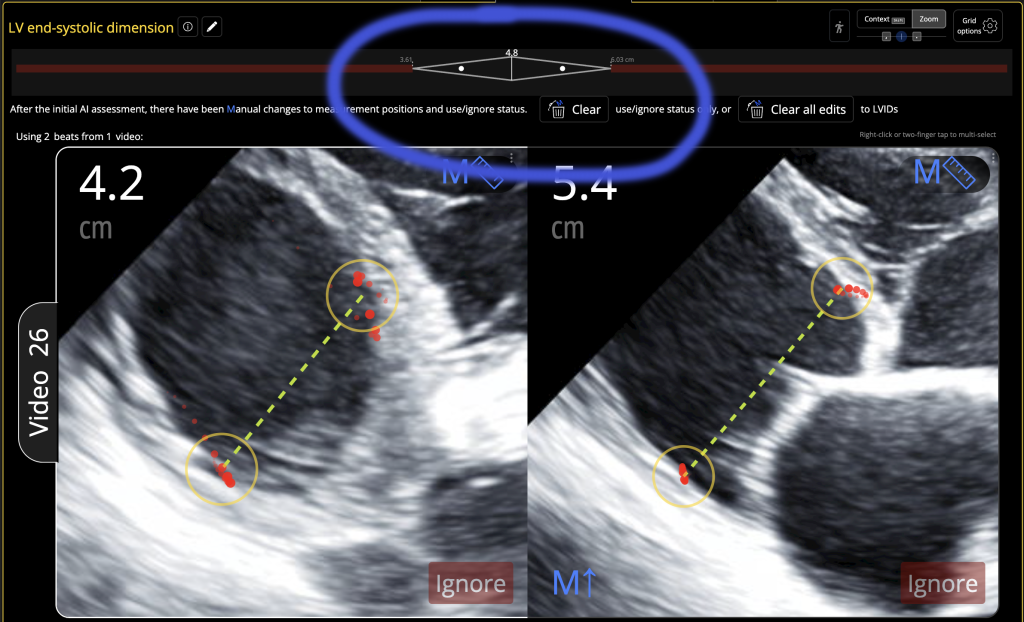
Responsibly designed AI software will alert users to these errors by plotting all measurements, making outliers immediately obvious. In the below example, the user has captured two right parasternal 4 chamber cine loops in a dog, but in one of them, the view becomes foreshortened part-way through the clip. The AI, having already correctly identified this as the correct video clip and also trained to pick the smallest dimension for its systolic measurement, erroneously measures this. The difference between the two measurements, plotted along a line and circled in blue, alert the user to a potential problem.
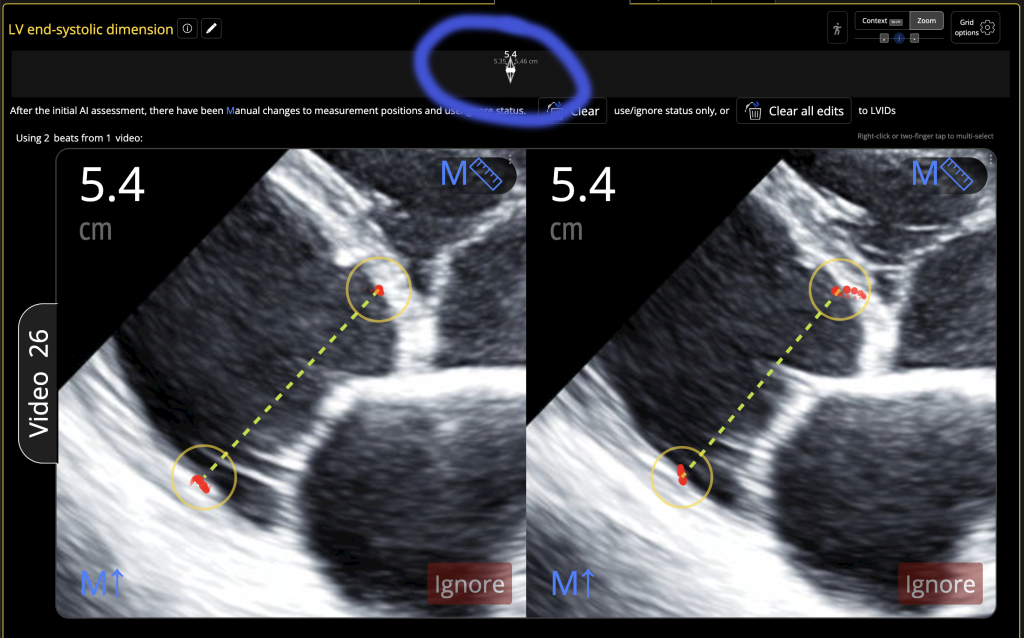
When the user rectifies the error, the points are now close together (in this case, identical).
Accepting that AI is fallible and finding ways to draw users’ attention to potential errors promotes its safe and responsible use. This is the opposite to large language models, trained instead to obscure errors, favouring sounding true over being true.
How can users spot errors?
Of course, users require some knowledge of the subject to be able to understand and rectify highlighted errors, even of quantitative AI. Responsible AI companies advocate for AI as a supporting tool only, in step with the user’s own experience level. While companies reselling large language models might say all the right things about AI never being a replacement for human expertise, when the AI spits out a highly detailed congenital heart disease echo report (as it did in our testing – incidentally, of a normal canine echo), this is going to be beyond the scope of a novice user’s experience.
It would be the easiest thing in the world for us to have AI generate a report. Because this report would be based off measurements made by expertly trained and validated neural networks, it would be of far greater accuracy than any other on the market. But we know that, from time to time, it would still get it wrong. If it gets it wrong on something which is outside of the ability of the user to notice and critically assess, that can irrevocably damage a veterinarian’s or entire clinic’s reputation, cost owners unnecessary money, and endanger patients lives. Put simply, it is dangerous and dishonest.
The dangerous rise of AI-generated echo reports in veterinary medicine
Yet, AI-generated reporting is precisely what we have seen entering the market mid-2026, and we are likely to see a lot more of it by this time next year. While no veterinarian would dream of using ChatGPT to interpret and report their echocardiogram, it’s easy to unwittingly end up subscribing to the exact same service when it’s wrapped up in a fancy website that talks a lot of transparency and validation – but without the studies to back any of this up.
When contemplating integrating AI support into your echocardiography reporting, look for the following red flags:
- Their AI generates text-only reports, and no automated quantification. Any measurements that are quoted are lifted from the measurements you yourself have performed during your exam. This indicates that the company has no in-house AI expertise and has invested nothing in training their own neural networks.
- They use all the right buzzwords – “transparency,” “trust,” “validation” – but have no peer-reviewed publications to back it up. Instead, you are invited to book a sales call so that you can see their internal (unpublished, unreviewed) validation work, which will invariably be a few hand-picked cases which they know to produce perfect reports.
- Implausibly high sensitivity and specificity. Currently, the highest published sensitivity and specificity scores for AI use in veterinary diagnostic imaging is in the 70s. If a company is quoting you numbers like 95% and 99% from their own internal validation studies, be suspicious about why they would not be tripping over themselves to publish these ground-breaking results.
If you do end up signing up or starting a free trial, try uploading your echo images and cine loops to ChatGPT alongside the ‘specialised’ reporting tool you have subscribed to. If the diagnosis is the same, how likely is it that this company has really trained AI models on hundreds of thousands of echocardiograms, as claimed?
References
Stowell CC, Kallassy V, Lane B, Abbott J, Borgeat K, Connolly D, Domenech O, Dukes-McEwan J, Ferasin L, Del Palacio JF, Linney C, Matos JN, Spalla I, Summerfield N, Vezzosi T, Howard JP, Shun-Shin MJ, Francis DP, Fuentes VL. Automated echocardiographic left ventricular dimension assessment in dogs using artificial intelligence: Development and validation. J Vet Intern Med. 2024 Mar-Apr;38(2):922-930. doi: 10.1111/jvim.17012. Epub 2024 Feb 16. PMID: 38362960; PMCID: PMC10937473.